
In this final article of the From Ambition to Adoption series, we explore another often-overlooked prerequisite for successful digital transformation: the need for a minimal shared language among all participants. This does not mean everyone needs to become an expert. It means making a limited but deliberate effort to master a common vocabulary that enables meaningful dialogue across roles and disciplines.
This also means challenging the traditional focus of project discussions. Too often, conversations revolve around features, functionalities, and technical specifications, along with their impact on budget and timing. These aspects matter, but they are rarely what determines success. The real challenge lies elsewhere: in understanding and removing the obstacles that prevent adoption in the field.
In the book From Ambition to Adoption, we identify eight domains in which project teams should build a shared understanding and a minimum common vocabulary:
- Agile collaboration
- User experience design
- Change management
- New business models
- Modularity and transparent architecture
- Cybersecurity
- Connectivity
- Data analytics

From Parallel Tracks to a Shared Journey
In many transformation projects, communication typically follows three separate tracks. Firstly, leadership defines the vision, mission, and strategic objectives. Secondly, project teams will focus on scope, budget, and planning. And finally, end users are represented through personas and user stories. While each perspective is important, the dialogue between them is often limited, creating misaligned expectations and reducing the likelihood of successful adoption, as explained in the figure below.
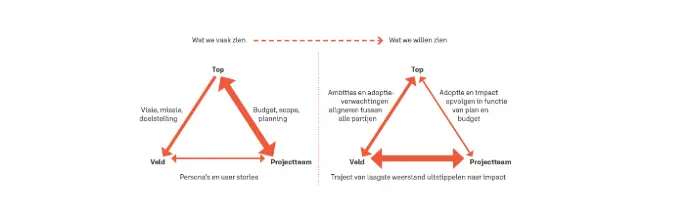
The most successful transformations replace these parallel conversations with a shared journey. Leaders, project teams, and operational stakeholders continuously align on ambitions, expected adoption levels, and the value to be created. Progress is therefore no longer measured solely by adherence to plan and budget, but by the degree to which people embrace new ways of working and deliver tangible business impact. By jointly identifying the path of least resistance and actively managing adoption throughout the project, organizations can significantly increase both the speed and the effectiveness of change.
Progress in digital transformation is not measured by the number of features delivered or requirements fulfilled, but by the adoption of solutions that create tangible business impact. A narrow focus on feature lists, specifications, and the corresponding budget can therefore be counterproductive. It risks reducing transformation to project delivery, while the real objective is to change how people work, decide, collaborate, and create value.
Because in the end, digital transformation is more than just about delivering features; it is also about changing behavior. And lasting value is then created only once people embrace and use the solutions that have been designed for them.
A lookback on what we’ve learned
As we reach the end of this journey, it is worth taking a moment to revisit the articles that make up this series. Each addresses a specific challenge of digital transformation and offers a distinct perspective on how organizations can create lasting value from technology. Here's what we've covered in the previous articles:
- Want Profound Change in Your Company? Start with a Clear Why
- Dream Big, Start Concrete
- Maximize Impact, Minimize Risk and Cost
- Love and Trust: The Way to your User’s Heart
- Design Constraints: Our Guide in Designing an Adoption-Ready Digital Solution
- The Orchestra of Digital Transformation: Who Plays Which Role?
- Your Project Has a Budget, a Plan, and a Feature List. Does It Have a Shared Language?
The technology you use acts merely as an enabler of your transition. Its value is determined by the extent to which it helps people perform their work better, make better decisions, collaborate more effectively, and create greater impact. That is why a successful digital transformation starts not with systems, platforms, or features, but with a deep understanding of the people who will use them.
When we place people at the center of design, technology becomes more than a technical solution. It becomes a catalyst for adoption, productivity, and meaningful change. Organizations that understand this simple principle consistently achieve better outcomes than those that view digital transformation as a purely technological challenge.
We hope that these articles will be of value to you and wish you all the success in turning your ambitions into widely adopted realities. If there is one message we want you to take away from this article series, it is this: the key element of your digital transformation is never the technology itself; it is rather the people who make room for its adoption.
If you would like a more personal and tailored guidance for your business, you can request a meeting with the authors through the following link: https://www.sustain.brussels/contactus
Previous Article: The Orchestra of Digital Transformation: Who Plays Which Role?
Your Project Has a Budget, a Plan, and a Feature List. Does it Have a Shared Language?